Why making work faster is not the same as making an organisation more effective.
An insurer introduces AI to accelerate claims processing. The technology performs as promised. Initial assessments that previously took hours can now be completed in minutes. Productivity reports show substantial improvements. The implementation team declares success.
The trouble is, customers aren't receiving settlements any faster.
The initial assessment was never the limiting factor. Specialist review and approval still determine how quickly claims can be settled. The AI has increased the amount of work reaching those teams without increasing their ability to process it.
If the insurer releases that additional work into the system, queues grow. Employees spend more time prioritising cases, answering enquiries and managing exceptions. Poorly handled cases may generate rework and further customer contact.
The technology has succeeded. The investment may not have.
This is a hypothetical example, but it illustrates a problem boards need to understand before approving substantial AI expenditure: improving the performance of an activity does not necessarily improve the performance of the organisation.
The difference between productivity and value
Much of the business case for AI rests on productivity. Tasks can be completed faster, documents generated more quickly, information analysed at greater scale and decisions supported with less manual effort.
These capabilities are potentially valuable. But a productivity improvement is not the same thing as an economic return. In some circumstances, making one activity faster can even make the organisation less effective, increasing costs or delays elsewhere in the system.
Consider an employee who spends four hours a week preparing reports. AI reduces that work to one hour.
Three hours have been gained. But what happens to those hours?
If the employee uses that time to perform other valuable work, the organisation may gain additional capacity. If the organisation can reduce expenditure without compromising service, it may realise a financial saving. If reports become more timely and improve decisions, the benefit may appear elsewhere.
But none of these outcomes follows automatically from the reduction in preparation time.
The distinction is between three things:
Technical performance: Does the AI perform the intended task?
Operational performance: Does using it improve how work is completed?
Economic value: Does that improvement produce an outcome the organisation values sufficiently to justify its investment?
An AI system can succeed at the first two without delivering the third. The business case needs to show how one leads to the next.
This is not an argument against investing in AI. It is an argument for being clear-eyed about what the investment is intended to achieve.
The bottleneck nobody asked about
The Theory of Constraints, associated with Eliyahu Goldratt, offers a useful way to examine this problem.
Its central insight is that the performance of a system is limited by its constraint. Improving the efficiency of activities elsewhere in the system does not necessarily increase overall throughput.
Imagine a claims process with three stages:
Initial assessment can process 80 claims per day.
Specialist review can process 60.
Settlement can process 100.
Assuming every claim passes through each stage, specialist review limits the system to 60 completed claims per day.
Now introduce AI that triples initial assessment capacity to 240 claims per day.
The system can still complete only 60 claims per day.
If all 240 assessed claims are released into specialist review each day, against capacity of just 60, the backlog grows by 180 claims per day. Lead times increase even though the first stage has become dramatically more productive. This assumes sufficient demand and no controls limiting the release of work into the next stage.
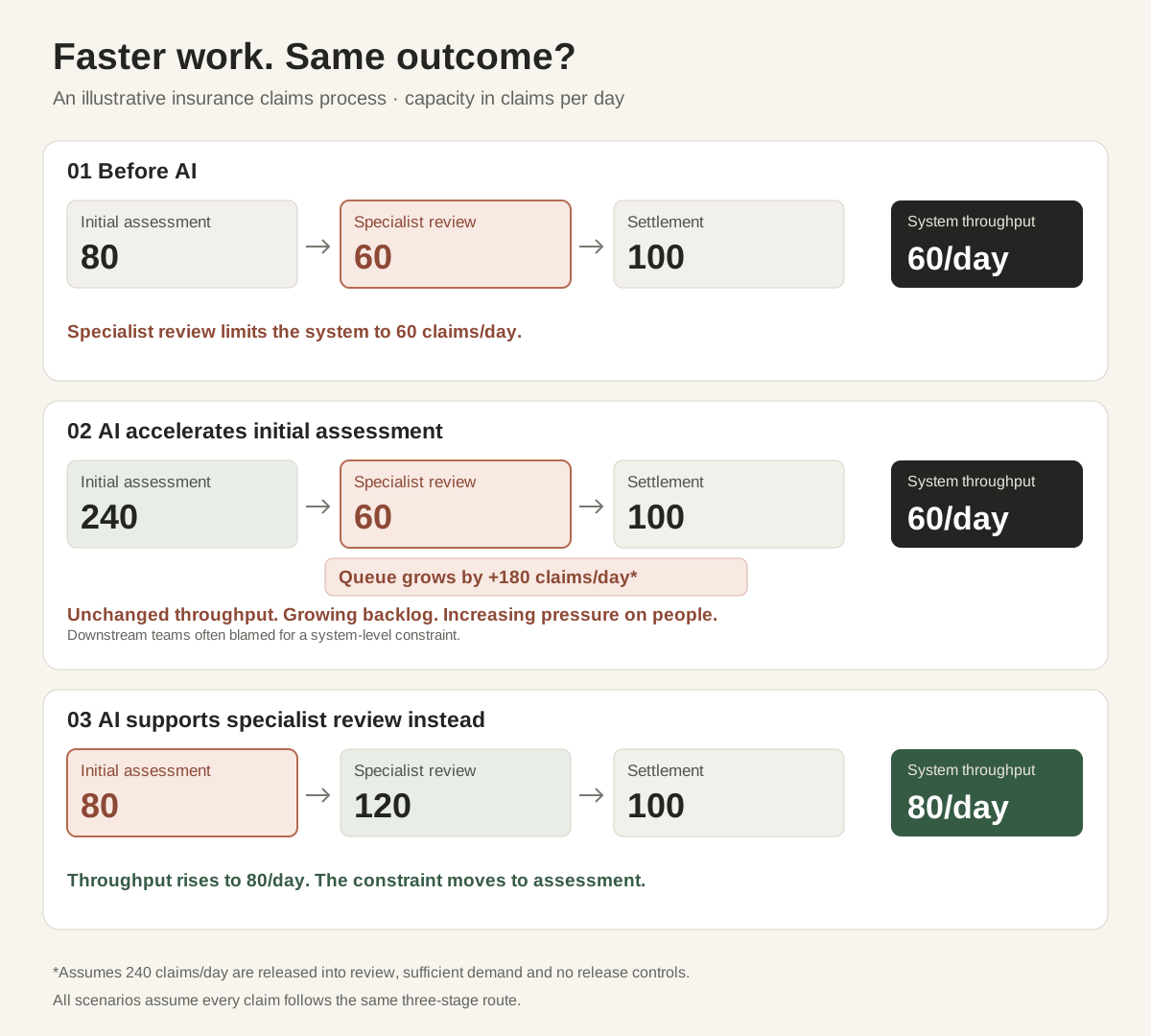
Illustrative daily capacities, not observed results. The growing backlog assumes 240 claims are released to specialist review each day; in practice, release controls or lower demand could prevent it.
There may be further consequences.
In knowledge work, these constraints can be surprisingly difficult for management to see. The queue is not a pile of parts on a factory floor; it is cases awaiting judgement, decisions awaiting approval and messages waiting for an answer. When upstream automation sends more work into that invisible queue, managers may interpret the continuing delays as poor performance by the downstream team rather than a predictable consequence of the system they have created. Criticism and pressure increase, even though the specialists are already working at capacity.
Employees dealing with growing queues can spend more time expediting urgent cases and explaining delays. If AI-generated assessments are incomplete or inaccurate, specialists may need to correct them. Customers who cannot obtain satisfactory answers may contact the insurer repeatedly.
Some of this is additional coordination work. Some, where it arises from a failure to do something correctly or meet a legitimate need, is what systems thinker John Seddon describes as failure demand.
In either case, the organisation risks consuming part of the productivity gain managing the consequences of its own operating system.
The relevant question is not simply how much faster AI can perform the activity. It is what happens to the whole system when that activity becomes faster.
When AI removes the constraint
There is an equally important counterargument.
Suppose the insurer instead uses AI to help specialist reviewers retrieve evidence, identify relevant policy conditions and prepare cases for human judgement.
If that intervention increases specialist review capacity from 60 to 120 claims per day, the constraint moves elsewhere. Initial assessment, at 80 claims per day, may now become the limiting factor.
The organisation could potentially complete 80 rather than 60 claims per day, provided there is sufficient demand and the other stages can support that throughput.
Here, AI has improved the performance of the system rather than merely one of its activities.
That is why Theory of Constraints should not be used as a blanket objection to automation. It is a way to distinguish investments that create local efficiency from those that improve end-to-end outcomes.
And not every organisational constraint is a processing bottleneck. Constraints may be operational (the capacity of a specialist team), organisational (decision rights or coordination), commercial (insufficient demand or an unviable proposition), or behavioural (incentives, trust or willingness to adopt a new way of working). Regulatory approval and scarce expertise may also determine what is possible.
Finding the constraint is therefore a starting point for organisational change, not a substitute for it. An investment creates value only when the organisation can adapt the surrounding work, decisions and incentives to use the new capability.
The board needs to understand which constraint matters to the proposed investment, and whether the intervention will relieve it, move it, or create new dependencies.
The investment outside the technology budget
There is another reason why AI investments may take longer to deliver value than their business cases suggest.
The technology is only one component of the investment.
Economists Erik Brynjolfsson, Daniel Rock and Chad Syverson describe a productivity J-curve associated with general-purpose technologies. Organisations must often make complementary investments in processes, skills and intangible capabilities before the benefits of a new technology become fully visible.
AI is a particularly relevant example.
A company might acquire sophisticated AI capabilities while leaving its decision-making structures, incentives, resource allocation and workflows largely unchanged.
Employees can perform tasks faster, but the organisation continues operating according to assumptions developed for an earlier technology environment.
The result is a mismatch between what the technology makes possible and what the organisation is designed to do.
This does not mean every AI investment requires a wholesale restructuring. Sometimes a modest workflow adjustment is sufficient. In other cases, capturing the benefits requires substantial changes to roles, authority, coordination and resource allocation.
Research into organisational structural change reinforces the importance of context. Luciano and colleagues' 2026 integrative review of 292 studies identifies interpretation, integration, coherence and investment as important mechanisms in how structural change unfolds.
The review is not specifically about AI, but it helps explain why introducing a technically sound solution into an incoherent operating model may create difficulties that technical optimisation alone cannot resolve.
For the board, the implication is straightforward.
If the expected return depends on changes outside the technology, those changes belong inside the investment case.
Their costs, risks, dependencies and ownership should be visible before approval, not discovered after deployment.
The human capabilities that make the investment work
Organisational value also depends on how people use AI.
A 2026 study by Lee and colleagues examined different modes of AI use in a writing-task experiment. Compared with working without AI, participants who relied on AI-generated outputs reported lower confidence in their own ability, reduced psychological ownership and less meaning in their work. A more active approach—drafting first, then using AI to refine the work—mitigated those effects.
The study has limitations, including its single-session experimental design and focus on writing tasks. It does not establish long-term effects on workforce capability or show that AI adoption inevitably damages it.
It does, however, illustrate why the design of human–AI collaboration matters.
An organisation may gain immediate output while changing the conditions through which employees develop expertise, exercise judgement and maintain accountability.
These are not merely human resources considerations. They can affect the organisation's future capacity to operate effectively, particularly when AI systems produce errors, encounter unfamiliar situations or become unavailable.
Boards should therefore examine not only what AI will automate, but what capabilities the organisation needs to retain, develop or create.
Five questions boards should ask before approving AI investment
The preceding arguments suggest five questions that deserve substantive answers in an AI investment proposal.
1. What organisational outcome are we buying?
The answer should be expressed in terms of business outcomes, not simply AI functionality or hours saved.
Are we seeking greater throughput, improved customer outcomes, lower operating costs, better decisions, reduced risk or new revenue?
What would demonstrate that the intended outcome had actually been achieved?
2. Where is the constraint, and what happens if the AI succeeds?
What currently limits the organisation's ability to achieve the desired outcome?
Will the AI intervention relieve that constraint, leave it unchanged or shift pressure elsewhere?
What happens to queues, handoffs, exceptions and demand if the proposed productivity improvements materialise?
This question is particularly important when a business case assumes that faster work at one stage will automatically translate into faster delivery overall.
3. What must change outside the technology?
Which workflows, skills, decision rights, incentives, controls and resource allocations need to change?
Who owns those changes, and have their costs been included?
A proposal that depends on organisational redesign but funds only technical deployment is not a complete investment proposal.
4. How will productivity improvements become economic value?
If AI releases employee time, what will the organisation do with that capacity?
If it improves throughput, is there sufficient demand to make use of the increase?
If it improves decision quality, how will the effect be measured?
This question forces the business case to explain the mechanism connecting an operational improvement to an economically meaningful result.
5. What evidence will cause us to continue, change or stop?
AI investment involves uncertainty. Boards should expect assumptions to be tested rather than treated as commitments that must be defended.
Which early indicators will demonstrate that the organisation is progressing towards value? What would indicate that the constraint has moved, that expected benefits are not materialising or that unintended costs are emerging?
What decisions will follow from that evidence?
Research on board effectiveness suggests that good governance depends substantially on how directors interpret information, challenge assumptions and learn together. An effective board does more than approve a proposal and monitor whether its milestones have been delivered.
It continues to examine whether the investment thesis remains valid.
Govern the path to value
AI can make organisations more productive. It can also improve decisions, extend capabilities and enable services that were previously uneconomic or impossible.
But the presence of a powerful technology does not establish the value of a particular investment.
That value depends on the organisation in which the technology operates: its constraints, structures, capabilities, customers and willingness to change how work is done. Technology can expand what is possible; organisational transformation determines how much of that possibility becomes value.
For boards, the task is not to become experts in every AI model or implementation technique. It is to understand the economic and organisational logic of the investments they are being asked to approve.
A convincing demonstration of technical capability is a starting point.
A credible explanation of how that capability will change organisational performance—and how the resulting value will be captured—is the investment case.
Before approving the next AI investment, find the constraint. Then ask what must change for the investment to make a difference.
Cortessian works with leadership teams to examine the organisational assumptions, dependencies and decisions behind AI investment. Learn more about our AI Advisory work.
References and further reading
Research briefings from The Oxford Review informed this article. The original research is credited below, together with the briefing in which it was reviewed. The interpretations and recommendations in this article are Cortessian's own.
- Brynjolfsson, E., Rock, D., & Syverson, C. (2021). The productivity J-curve: How intangibles complement general purpose technologies. American Economic Journal: Macroeconomics, 13(1), 333–372.
- Luciano, M. M., Watson, M. K., Kabra, A., & Winchester, C. C. (2026). Why and how organizational structures change: An integrative review and framework. Academy of Management Annals, 20(1), 400–450. In Why and how organisational structures change. Research Briefing. The Oxford Review. www.oxford-review.com.
- Lee, E. H., Yin, Y., Jia, N., & Wakslak, C. J. (2026). Relying on AI at work reduces self-efficacy, ownership, and meaning while active collaboration mitigates the effects. Scientific Reports. In How the way artificial intelligence is used at work shapes competence, ownership and meaning. Research Briefing. The Oxford Review. www.oxford-review.com.
- Capezio, A., Keshavarzsaleh, A., & Shrestha, R. K. (2026). Board effectiveness in contemporary organizations: Integrating the board practitioner and scholarly literatures. Academy of Management Annals. In Board Effectiveness Depends on how the Board Thinks. Research Briefing. The Oxford Review. www.oxford-review.com.
The Strategic Flow glossary provides short explanations of Theory of Constraints, throughput and failure demand, referenced in the article.